
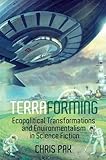
Terraforming Ecopolitical Transformations and Environmentalism in Science Fiction / Chris Pak.
Material type: TextPublisher: Liverpool University Press, Description: 1 online resource (262 p.)ISBN: 9781781384541Subject(s): Literary Criticism / Subjects & Themes / Politics | Literary Criticism / Science Fiction & Fantasy | Literature -- History and criticismGenre/Form: Electronic books.Online resources: View this content on Open Research Library. Summary: Terraforming is the process of making other worlds habitable for human life. Its counterpart on Earth-geoengineering- is receiving serious consideration as a way to address climate change. Contemporary environmental awareness and our understanding of climate change is influenced by science fiction, and terraforming in particular has offered scientists, philosophers, and others a motif for thinking in complex ways about our impact on planetary environments. This book asks how science fiction has imagined how we shape both our world and other planets and how stories of terraforming reflect on science, society and environmentalism. It traces the growth of the motif of terraforming in science fiction from H.G. Wells's The War of the Worlds (1898) to James Cameron's blockbuster Avatar (2009), in stories by such writers as Olaf Stapledon, Ray Bradbury, Robert Heinlein, Arthur C. Clarke, Frank Herbert, Ursula K. Le Guin, Ernest Callenbach, Pamela Sargent, Frederick Turner and Kim Stanley Robinson. It argues for terraforming as a nexus for environmental philosophy, the pastoral, ecology, the Gaia hypothesis, and the politics of colonisation and habitation. Amidst contemporary anxieties about climate change, terraforming offers an important vantage from which to consider the ways humankind shapes and is shaped by their world.
| Item type | Current library | Call number | URL | Status | Date due | Barcode | Item holds |
|---|---|---|---|---|---|---|---|
 eBook
eBook
|
Digital Library
Resources in this library are accessible in digital format e.g. eBooks or eJournals accessible online. |
Link to resource | Available | ||||
|
eBook
|
Digital Library
Resources in this library are accessible in digital format e.g. eBooks or eJournals accessible online. |
Link to resource | Available | ||||
|
eBook
|
Digital Library
Resources in this library are accessible in digital format e.g. eBooks or eJournals accessible online. |
PN3433.6 .P355 2016 (Browse shelf(Opens below)) | Link to resource | Available |
Access copy available to the general public. Unrestricted star
Terraforming is the process of making other worlds habitable for human life. Its counterpart on Earth-geoengineering- is receiving serious consideration as a way to address climate change. Contemporary environmental awareness and our understanding of climate change is influenced by science fiction, and terraforming in particular has offered scientists, philosophers, and others a motif for thinking in complex ways about our impact on planetary environments. This book asks how science fiction has imagined how we shape both our world and other planets and how stories of terraforming reflect on science, society and environmentalism. It traces the growth of the motif of terraforming in science fiction from H.G. Wells's The War of the Worlds (1898) to James Cameron's blockbuster Avatar (2009), in stories by such writers as Olaf Stapledon, Ray Bradbury, Robert Heinlein, Arthur C. Clarke, Frank Herbert, Ursula K. Le Guin, Ernest Callenbach, Pamela Sargent, Frederick Turner and Kim Stanley Robinson. It argues for terraforming as a nexus for environmental philosophy, the pastoral, ecology, the Gaia hypothesis, and the politics of colonisation and habitation. Amidst contemporary anxieties about climate change, terraforming offers an important vantage from which to consider the ways humankind shapes and is shaped by their world.
Description based on print version record.
Knowledge Unlatched Round 2
There are no comments on this title.