
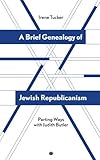
A Brief Genealogy of Jewish Republicanism: Parting Ways with Judith Butler Irene Tucker.
Material type: TextPublisher: Project Muse, Manufacturer: Project MUSE, Description: 1 online resource (90 pages)ISBN: 9780998237596Subject(s): Jews -- Identity | Zionism -- HistoryGenre/Form: Electronic books. | Electronic books. Additional physical formats: Print version:: No titleLOC classification: DS149 | .T836 2016Online resources: Full text available: Summary: A Brief Genealogy of Jewish Republicanism: Parting Ways with Judith Butler uses the chance synchronicity of the 2013 Israeli parliamentary elections and literary theorist Judith Butler's controversial Brooklyn College address calling for the boycotting of Israeli academic, cultural, and economic institutions as an occasion for examining possible relations between Jewishness and state-centered forms of self-governance. In an extended analysis of Butler's Parting Ways: Jewishness and the Critique of Zionism, Tucker shows how the alignment of certain authors' identities and ideas undergirding Butler's analytical framework draws upon a pointedly Christian conception of belief. This Christian conception of belief structures the most familiar understandings of modern secularism, articulated most famously by John Locke in his "Letter Concerning Toleration." Tucker reads Locke's "Letter"' alongside Jewish philosopher/rabbi Moses Mendelssohn's 1783 critique of Locke, Jerusalem: Or On Religious Power and Judaism, and the Jewish tradition of the minyan, making a case for the existence of an alternative history of publicness borrowing from Jewish conceptions of communal life and the proper relations of actions and ideas. In throwing light on a genealogy of Jewish practices aimed at the deliberate creation of collectives constituted by their grappling with contingent, historical time, Tucker argues for the existence of a Jewish tradition of republicanism, of democracy. Within such a context, the Jewishness of Israel can be seen to lie first and foremost in its methods of generating a civil collective out of a diverse citizenry rather than in the identities of its individual citizens. The tradition Tucker has in mind explicitly uses an idea of ritual or "ceremonial law" to sustain within itself a tension between a heterogeneity of perspectives and interests constitutive of democratic process and the forms of unity and agreement often understood to be the desired outcome of that process. By setting forth a framework in which heterogeneity and agreement are conceived as coincident modes of political being rather than steps in a linear process, this "Jewish republicanism" frames law-making, implementation and following as forms of a single structure of ritual practice. Such a framework might provide the inspiration and authority for reconceiving some of the fundamental relations of the Zionist project.
| Item type | Current library | Call number | URL | Status | Date due | Barcode | Item holds |
|---|---|---|---|---|---|---|---|
 eBook
eBook
|
Digital Library
Resources in this library are accessible in digital format e.g. eBooks or eJournals accessible online. |
DS149 .T836 2016 (Browse shelf(Opens below)) | Link to resource | Available |
Issued as part of book collections on Project MUSE.
Includes bibliographical references.
Open Access Unrestricted online access star
A Brief Genealogy of Jewish Republicanism: Parting Ways with Judith Butler uses the chance synchronicity of the 2013 Israeli parliamentary elections and literary theorist Judith Butler's controversial Brooklyn College address calling for the boycotting of Israeli academic, cultural, and economic institutions as an occasion for examining possible relations between Jewishness and state-centered forms of self-governance. In an extended analysis of Butler's Parting Ways: Jewishness and the Critique of Zionism, Tucker shows how the alignment of certain authors' identities and ideas undergirding Butler's analytical framework draws upon a pointedly Christian conception of belief. This Christian conception of belief structures the most familiar understandings of modern secularism, articulated most famously by John Locke in his "Letter Concerning Toleration." Tucker reads Locke's "Letter"' alongside Jewish philosopher/rabbi Moses Mendelssohn's 1783 critique of Locke, Jerusalem: Or On Religious Power and Judaism, and the Jewish tradition of the minyan, making a case for the existence of an alternative history of publicness borrowing from Jewish conceptions of communal life and the proper relations of actions and ideas. In throwing light on a genealogy of Jewish practices aimed at the deliberate creation of collectives constituted by their grappling with contingent, historical time, Tucker argues for the existence of a Jewish tradition of republicanism, of democracy. Within such a context, the Jewishness of Israel can be seen to lie first and foremost in its methods of generating a civil collective out of a diverse citizenry rather than in the identities of its individual citizens. The tradition Tucker has in mind explicitly uses an idea of ritual or "ceremonial law" to sustain within itself a tension between a heterogeneity of perspectives and interests constitutive of democratic process and the forms of unity and agreement often understood to be the desired outcome of that process. By setting forth a framework in which heterogeneity and agreement are conceived as coincident modes of political being rather than steps in a linear process, this "Jewish republicanism" frames law-making, implementation and following as forms of a single structure of ritual practice. Such a framework might provide the inspiration and authority for reconceiving some of the fundamental relations of the Zionist project.
Description based on print version record.
There are no comments on this title.