
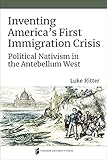
Inventing America's First Immigration Crisis Political Nativism in the Antebellum West / Luke Ritter.
Material type: TextSeries: Catholic practice in North AmericaPublisher: Fordham University Press, Manufacturer: Project MUSE, Edition: First editionDescription: 1 online resource (1 EPUB unpaged.)ISBN: 9780823289868Subject(s): Religion -- History -- Political aspects -- West (U.S.) -- 19th century | Immigrants -- West (U.S.) -- Religious aspects -- 19th century | Religion -- History -- 19th century | Nativism -- History -- 19th century | Anti-Catholicism -- West (U.S.) -- History -- 19th centuryGenre/Form: Electronic books. | Electronic books. Additional physical formats: Print version:: No titleLOC classification: BX1770 | .R585 2020Online resources: Full text available: Summary: Why have Americans expressed concern about immigration at some times but not at others? In pursuit of an answer, this book examines America's first nativist movement, which responded to the rapid influx of 4.2 million immigrants between 1840 and 1860 and culminated in the dramatic rise of the National American Party. As previous studies have focused on the coasts, historians have not yet completely explained why westerners joined the ranks of the National American, or "Know Nothing," Party or why the nation's bloodiest anti-immigrant riots erupted in western cities--namely Chicago, Cincinnati, Louisville, and St. Louis. In focusing on the antebellum West, Inventing America's First Immigration Crisis illuminates the cultural, economic, and political issues that originally motivated American nativism and explains how it ultimately shaped the political relationship between church and state. In six detailed chapters, Ritter explains how unprecedented immigration from Europe and rapid westward expansion reignited fears of Catholicism as a corrosive force. He presents new research on the inner sanctums of the secretive Order of Know-Nothings and provides original data on immigration, crime, and poverty in the urban West. Ritter argues that the country's first bout of political nativism actually renewed Americans' commitment to church-state separation. Native-born Americans compelled Catholics and immigrants, who might have otherwise shared an affinity for monarchism, to accept American-style democracy. Catholics and immigrants forced Americans to adopt a more inclusive definition of religious freedom. This study offers valuable insight into the history of nativism in U.S. politics and sheds light on present-day concerns about immigration, particularly the role of anti-Islamic appeals in recent elections.
| Item type | Current library | Call number | URL | Status | Date due | Barcode | Item holds |
|---|---|---|---|---|---|---|---|
 eBook
eBook
|
Digital Library
Resources in this library are accessible in digital format e.g. eBooks or eJournals accessible online. |
BX1770 .R585 2020 (Browse shelf(Opens below)) | Link to resource | Available |
Browsing Digital Library shelves, Shelving location: Online Access Close shelf browser (Hides shelf browser)

|

|

|

|

|

|

|
||
| BX1533.T69 F37 1991 Communities of Saint Martin | BX1740.M6 J83 1996 Relación de la causa de Juana María, mulata | BX1740.M6 M56 2001 Secretos del oficio | BX1770 .R585 2020 Inventing America's First Immigration Crisis | BX1912.2 .P488 2020 Womanpriest | BX3746.C5 D83 2009 La introducción del aristotelismo en China a través del De anima | BX4705.B5195 D88 2017 A Vietnamese Moses |
Revision of author's thesis (doctroal)--Saint Louis University, 2013, titled Anti-Catholic America : nativism and religious freedom in the antebellum West.
Issued as part of book collections on Project MUSE.
Includes bibliographical references.
Open Access Unrestricted online access star
Why have Americans expressed concern about immigration at some times but not at others? In pursuit of an answer, this book examines America's first nativist movement, which responded to the rapid influx of 4.2 million immigrants between 1840 and 1860 and culminated in the dramatic rise of the National American Party. As previous studies have focused on the coasts, historians have not yet completely explained why westerners joined the ranks of the National American, or "Know Nothing," Party or why the nation's bloodiest anti-immigrant riots erupted in western cities--namely Chicago, Cincinnati, Louisville, and St. Louis. In focusing on the antebellum West, Inventing America's First Immigration Crisis illuminates the cultural, economic, and political issues that originally motivated American nativism and explains how it ultimately shaped the political relationship between church and state. In six detailed chapters, Ritter explains how unprecedented immigration from Europe and rapid westward expansion reignited fears of Catholicism as a corrosive force. He presents new research on the inner sanctums of the secretive Order of Know-Nothings and provides original data on immigration, crime, and poverty in the urban West. Ritter argues that the country's first bout of political nativism actually renewed Americans' commitment to church-state separation. Native-born Americans compelled Catholics and immigrants, who might have otherwise shared an affinity for monarchism, to accept American-style democracy. Catholics and immigrants forced Americans to adopt a more inclusive definition of religious freedom. This study offers valuable insight into the history of nativism in U.S. politics and sheds light on present-day concerns about immigration, particularly the role of anti-Islamic appeals in recent elections.
Description based on print version record.
There are no comments on this title.