
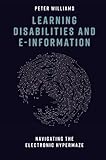
Learning disabilities and e-information : navigating the electronic hypermaze / authored by Peter Williams (University College London, UK).
Material type: TextPublisher: Emerald Publishing Limited, Description: 1 online resource (xvi, 178 pages) ; cmISBN: 9781789731538Subject(s): Learning disabilities | Cyberinfrastructure | Education -- Special Education -- Developmental & Intellectual Disabilities | Teaching of students with specific learning difficulties, needsAdditional physical formats: No titleDDC classification: 371.9 LOC classification: LC4704 | .W55 2020Online resources: Click here to access online
 | Item type | Current library | Call number | URL | Status | Date due | Barcode | Item holds |
|---|---|---|---|---|---|---|---|
 eBook
eBook
|
Digital Library
Resources in this library are accessible in digital format e.g. eBooks or eJournals accessible online. |
LC4704 .W55 2020 (Browse shelf(Opens below)) | Link to resource | Available |
Includes bibliographical references and index.
Chapter 1. Definitions, models, needs -- Chapter 2. Issues inherent in researching learning disabilities -- Chapter 3. The web and people with learning disabilities -- Chapter 4. Methods to test website usability -- Chapter 5. Website usability - eliciting the issues -- Chapter 6. The use of images -- Chapter 7. Investigating the attributes elicited in consort -- Chapter 8. 'Serial access' to information -- Chapter 9. 'Random','direct' and 'iterative' access -- Chapter 10. Examining website preferences -- Chapter 11. A shrinking world: mobile devices and usability -- Chapter 12. Testing the usability of a mobile app -- Chapter 13. Facilitating information access -- Chapter 14. Conclusion.
Digital Technology is becoming ever more used by people with learning disabilities for information, entertainment and to enjoy self-expression. Despite this, there is a paucity of research into how this cohort negotiate electronic interfaces, interpret images, navigate pages and read online; what barriers there might be, and how these could be obviated. This book explores these issues, establishing how these and other factors facilitate or inhibit information access and behaviour more generally. There are plenty of guidelines and accessibility standards regarding electronic information presentation, but most are outdated or have been formulated without empirical evidence. Unlike prior literature this book is the result of many years's research in the field, considers specific information contexts, and develops new concepts in information behaviour. It is written in non-technical, jargon-free language, relevant for academics, students and professionals; from human-computer interaction researchers, learning disability specialists and information scientists to formal and informal carers and supporters, college tutors, family members and others.
Print version record.
There are no comments on this title.