
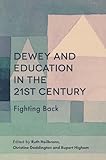
Dewey and education in the 21st century : fighting back / edited by Ruth Heilbronn, Christine Doddington and Rupert Higham.
Material type: TextPublisher: Emerald Publishing Limited, Description: 1 online resource (xix, 228 pages)ISBN: 9781787436251 (e-book)Subject(s): Education -- Philosophy | Experiential learning | Dewey, John, 1859-1952 | Education, Philosophy, Theory & Social Aspects | Philosophy & theory of educationAdditional physical formats: No titleDDC classification: 370.1 LOC classification: LB875.D5 | D49 2018Online resources: Click here to access online Summary: This book makes a strong case for the abiding relevance of Deweys notion of learning through experience, with a community of others and what this implies for democratic education in the 21st century. Its first section addresses the experience of todays generation of so-called digital natives in terms of how we should now understand knowledge and how their online experience creates opportunities and challenges for the curriculum, such as schools linking internationally to study classical texts; an exposition of why makerspaces, hackerspaces and Fab Labs might support Deweys democratic communities in our time, with on-line affordances of a commons, a space to use imagination and invent and share with others.The books second section is original in its focus on the central Deweyan idea of embodiment with chapters on Dewey and the Alexander technique and on experiences of Afro-American students, in public schools, especially those situated in multi-racial, multi-ethnic countries like the U.S. with deep, racial divides and tensions. The section ends with a chapter on the somaesthetic, educational value of learning outside of buildings.A third section on experience related to democracy and education, has chapters on Dewey and the democratic curriculum, experience as a preparation for democracy, communication and the critique of individualism. Deweys notion of interest is analyzed and questioned as to whether it is a sympathetic notion for educational development. With contributions from Spain, Cameroon, the US and the UK the book ranges across varied curricular and policy contexts to explore what reading Dewey can contribute to contemporary education studies.
| Item type | Current library | Call number | URL | Status | Date due | Barcode | Item holds |
|---|---|---|---|---|---|---|---|
 eBook
eBook
|
Digital Library
Resources in this library are accessible in digital format e.g. eBooks or eJournals accessible online. |
LB875.D5 D49 2018 (Browse shelf(Opens below)) | Link to resource | Available |
Browsing Digital Library shelves, Shelving location: Online Access Close shelf browser (Hides shelf browser)

|

|

|

|

|
No cover image available |

|
||
| LB45 .I34 2004 Identity, agency and social institutions in educational ethnography | LB45 .M48 2007 Methodological developments in ethnography | LB45 .N489 2016 New directions in educational ethnography / | LB875.D5 D49 2018 Dewey and education in the 21st century : | LB1025.3 B38 2015 Teaching in a digital age / | LB1025.3 .B38 2019eb Teaching in a digital age : | LB1025.3 .E87 2020 Exploring self toward expanding teaching, teacher education and practitioner research / |
Includes index.
Includes bibliographical references.
This book makes a strong case for the abiding relevance of Deweys notion of learning through experience, with a community of others and what this implies for democratic education in the 21st century. Its first section addresses the experience of todays generation of so-called digital natives in terms of how we should now understand knowledge and how their online experience creates opportunities and challenges for the curriculum, such as schools linking internationally to study classical texts; an exposition of why makerspaces, hackerspaces and Fab Labs might support Deweys democratic communities in our time, with on-line affordances of a commons, a space to use imagination and invent and share with others.The books second section is original in its focus on the central Deweyan idea of embodiment with chapters on Dewey and the Alexander technique and on experiences of Afro-American students, in public schools, especially those situated in multi-racial, multi-ethnic countries like the U.S. with deep, racial divides and tensions. The section ends with a chapter on the somaesthetic, educational value of learning outside of buildings.A third section on experience related to democracy and education, has chapters on Dewey and the democratic curriculum, experience as a preparation for democracy, communication and the critique of individualism. Deweys notion of interest is analyzed and questioned as to whether it is a sympathetic notion for educational development. With contributions from Spain, Cameroon, the US and the UK the book ranges across varied curricular and policy contexts to explore what reading Dewey can contribute to contemporary education studies.
Print version record
There are no comments on this title.