
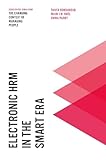
Electronic HRM in the smart era / edited by Tanya Bondarouk, Huub J. M. Ru�el, Emma Parry.
Material type: TextSeries: The changing context of managing peoplePublisher: Emerald Publishing Limited, Description: 1 online resource (280 pages)ISBN: 9781787143159Subject(s): Personnel management -- Technological innovations | Business & Economics -- Organizational Behavior | Organizational theory & behaviourAdditional physical formats: No titleDDC classification: 658.300285 LOC classification: HF5549.5.T33 | E44 2017Online resources: Click here to access online Summary: The HRM field is entering smart businesses where the human,digital and high-tech dimensions seem to increasingly converge, and HRM needsto anticipate its own "smart" future. Technological developments andinterconnectedness with and through the Internet (often called the "Internet of Things") set new challenges for the HRM function. Smartness enacted by HRMprofessionals - notions of "smart industries", "smart things" and "smartservices" all put new pressures on strategic HRM. Since the 1990s,organisations have increasingly been introducing electronic Human ResourceManagement (e-HRM), with the expectation of improving the quality of HRM andincreasing its contribution to firm performance. These beliefs originate fromideas about the endless possibilities of information technologies (IT) infacilitating HR practices, and about the infinite capacity of HRM to adopt IT.This book focuses on the progression from e-HRM to digital HRM towards smart HRM. It also raises several important questions that businessesand scholars are confronted with: What kind of smart solution can and will HRM offer to meet the expectations of thelatest business developments? Can HRM become "smart" and combinedigitisation, automation and a network approach? How do businesses futureprooftheir HRM in the smart era? What competences do employees need to ensurebusinesses flourish in smart industries? With rapid technological developments and ever-greater automation andinformation available, the HRM function needs to focus on non-routine andcomplex, evidence-based and science-inspired, and creative and value-addedprofessionally demanding tasks.
| Item type | Current library | Call number | URL | Status | Date due | Barcode | Item holds |
|---|---|---|---|---|---|---|---|
 eBook
eBook
|
Digital Library
Resources in this library are accessible in digital format e.g. eBooks or eJournals accessible online. |
HF5549.5.T33 E44 2017 (Browse shelf(Opens below)) | Link to resource | Available |
Browsing Digital Library shelves, Shelving location: Online Access Close shelf browser (Hides shelf browser)

|

|

|

|

|

|

|
||
| HF5549.5.P37 P47 2012 Performance measurement and management control | HF5549.5.P37 S35 2004 The science and simulation of human performance | HF5549.5.R44 H37 2019 Onboarding : | HF5549.5.T33 E44 2017 Electronic HRM in the smart era / | HF5549.5.T33 H86 2020 Human & technological resource management (HTRM) : | HF5549.5.T7 D43 2017 The future of corporate universities : | HF5601 .M36 2013 Managing reality |
Includes index.
Includes bibliographical references.
The HRM field is entering smart businesses where the human,digital and high-tech dimensions seem to increasingly converge, and HRM needsto anticipate its own "smart" future. Technological developments andinterconnectedness with and through the Internet (often called the "Internet of Things") set new challenges for the HRM function. Smartness enacted by HRMprofessionals - notions of "smart industries", "smart things" and "smartservices" all put new pressures on strategic HRM. Since the 1990s,organisations have increasingly been introducing electronic Human ResourceManagement (e-HRM), with the expectation of improving the quality of HRM andincreasing its contribution to firm performance. These beliefs originate fromideas about the endless possibilities of information technologies (IT) infacilitating HR practices, and about the infinite capacity of HRM to adopt IT.This book focuses on the progression from e-HRM to digital HRM towards smart HRM. It also raises several important questions that businessesand scholars are confronted with: What kind of smart solution can and will HRM offer to meet the expectations of thelatest business developments? Can HRM become "smart" and combinedigitisation, automation and a network approach? How do businesses futureprooftheir HRM in the smart era? What competences do employees need to ensurebusinesses flourish in smart industries? With rapid technological developments and ever-greater automation andinformation available, the HRM function needs to focus on non-routine andcomplex, evidence-based and science-inspired, and creative and value-addedprofessionally demanding tasks.
Print version record
There are no comments on this title.