
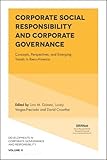
Corporate social responsibility and corporate governance : concepts, perspectives and emerging trends in Ibero-America / edited by Lina M. Gómez, Lucely Vargas-Preciado, David Crowther.
Material type: TextSeries: Developments in corporate governance and responsibility ; 11.Publisher: Emerald Publishing Limited, Description: 1 online resource (xv, 328 pages)ISBN: 9781787144118Subject(s): Corporate governance | Social responsibility of business | Business & Economics -- Corporate Governance | Corporate governanceAdditional physical formats: No titleDDC classification: 658.4 LOC classification: HD2741 | .C67 2017Online resources: Click here to access online
 | Item type | Current library | Call number | URL | Status | Date due | Barcode | Item holds |
|---|---|---|---|---|---|---|---|
 eBook
eBook
|
Digital Library
Resources in this library are accessible in digital format e.g. eBooks or eJournals accessible online. |
HD2741 .C67 2017 (Browse shelf(Opens below)) | Link to resource | Available |
Includes index.
Includes bibliographical references.
Prelims -- Theoretical perspectives -- Empirical perspectives -- Case studies -- About the Authors -- Index.
The practice of Corporate Social Responsibility (CSR) has been growing in attention, importance, significance, and acceptance in recent decades. CSR has been included in multiple debates, comments, theories, studies and research around the world. In the last decade, Ibero-America (including Brazil, Portugal, and Spain), has grown in economic terms, and corporate responsible practices have played a key role. A CSR approach in community-based experience has emerged in the last years in this region. This is due to the support of multilateral agencies that have served as a link between government, private sector and society. However, there are still many inequalities in this region. Therefore, this edited book focuses on how CSR and Corporate Governance in Ibero-America have been employed, analyzed, and examined in different sectors and scenarios (companies, NGOs, higher educational institutions, government). It does so from theoretical (theory development), conceptual, methodological, and empirical approaches. It takes a trans-regional approach unlike most research which has been focused on studying specific initiatives or experiences in a particular country.
Print version record
There are no comments on this title.