
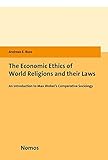
The Economic Ethics of World Religions and their Laws An Introduction to Max Weber's Comparative Sociology / Andreas Buss.
Material type: TextPublisher: Nomos Verlagsgesellschaft mbH & Co. KG, Description: 1 online resource (1 p.)ISBN: 9783845265834Subject(s): Technology & Engineering / Agriculture | Social Science / Sociology | Social sciencesGenre/Form: Electronic books.Online resources: View this content on Open Research Library. Summary: Based on analyses of the essays written by Max Weber on China, India, ancient Judaism and also on the dispersed material about Islam, Eastern Christianity and Occidental Christianity, this book examines the economic ethics of Asian and Christian traditions and their corresponding legal systems. Drawing also on Weber's methodology (particularly the concept of adequate causation), the author reveals that the nature of Asian religions as well as the nature of customary and other not formally rational laws in Asian cultures could not lead to modern capitalism out of their own sources, although capitalism could be adopted from the outside. The culture of the Occident, upon which capitalism is based, is revealed to consist of a double rationalisation: the formal rationality of the exterior circumstances of life (administrative and legal) and the innerworldly practical rationality of the inner motivations of the Protestants, supported by a goal-oriented rational technology.
| Item type | Current library | Call number | URL | Status | Date due | Barcode | Item holds |
|---|---|---|---|---|---|---|---|
 eBook
eBook
|
Digital Library
Resources in this library are accessible in digital format e.g. eBooks or eJournals accessible online. |
Link to resource | Available |
Access copy available to the general public. Unrestricted star
Based on analyses of the essays written by Max Weber on China, India, ancient Judaism and also on the dispersed material about Islam, Eastern Christianity and Occidental Christianity, this book examines the economic ethics of Asian and Christian traditions and their corresponding legal systems. Drawing also on Weber's methodology (particularly the concept of adequate causation), the author reveals that the nature of Asian religions as well as the nature of customary and other not formally rational laws in Asian cultures could not lead to modern capitalism out of their own sources, although capitalism could be adopted from the outside. The culture of the Occident, upon which capitalism is based, is revealed to consist of a double rationalisation: the formal rationality of the exterior circumstances of life (administrative and legal) and the innerworldly practical rationality of the inner motivations of the Protestants, supported by a goal-oriented rational technology.
Description based on print version record.
There are no comments on this title.