
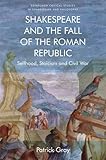
Shakespeare and the Fall of the Roman Republic Selfhood, Stoicism and Civil War / Patrick Gray.
Material type: TextPublisher: Edinburgh University Press, Description: 1 online resource (1 p.)ISBN: 9781474427470Subject(s): Literary Criticism / Shakespeare | Literature -- History and criticismGenre/Form: Electronic books.Online resources: View this content on Open Research Library. Summary: Shakespeare and the Fall of the Roman Republic introduces Shakespeare as a historian of ancient Rome alongside figures such as Sallust, Cicero, St Augustine, Machiavelli, Gibbon, Hegel and Nietzsche. In Julius Caesar and Antony and Cleopatra, Shakespeare shows Rome's transition from Republic to Empire. Why did Rome degenerate into an autocracy? Alternating between ruthless competition, Stoicism, Epicureanism and self-indulgent fantasies, Rome as Shakespeare sees it is inevitably bound for civil war. Shakespeare and the Fall of the Roman Republic considers Shakespeare's place in the history of concepts of selfhood and reflects on his sympathy for Christianity, in light of his reception of medieval Biblical drama, as well as his allusions to the New Testament. Shakespeare's critique of Romanitas anticipates concerns about secularisation, individualism and liberalism shared by philosophers such as Hannah Arendt, Alasdair MacIntyre, Charles Taylor, Michael Sandel and Patrick Deneen.
| Item type | Current library | Call number | URL | Status | Date due | Barcode | Item holds |
|---|---|---|---|---|---|---|---|
 eBook
eBook
|
Digital Library
Resources in this library are accessible in digital format e.g. eBooks or eJournals accessible online. |
Link to resource | Available |
Access copy available to the general public. Unrestricted star
Shakespeare and the Fall of the Roman Republic introduces Shakespeare as a historian of ancient Rome alongside figures such as Sallust, Cicero, St Augustine, Machiavelli, Gibbon, Hegel and Nietzsche. In Julius Caesar and Antony and Cleopatra, Shakespeare shows Rome's transition from Republic to Empire. Why did Rome degenerate into an autocracy? Alternating between ruthless competition, Stoicism, Epicureanism and self-indulgent fantasies, Rome as Shakespeare sees it is inevitably bound for civil war. Shakespeare and the Fall of the Roman Republic considers Shakespeare's place in the history of concepts of selfhood and reflects on his sympathy for Christianity, in light of his reception of medieval Biblical drama, as well as his allusions to the New Testament. Shakespeare's critique of Romanitas anticipates concerns about secularisation, individualism and liberalism shared by philosophers such as Hannah Arendt, Alasdair MacIntyre, Charles Taylor, Michael Sandel and Patrick Deneen.
Description based on print version record.
KU Select 2019: HSS Backlist Books
There are no comments on this title.