
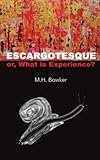
Escargotesque, or, What Is Experience M.H. Bowker.
Material type: TextPublisher: BABEL Working Group, Manufacturer: Project MUSE, Description: 1 online resource (1 online resource 116 pages) : illustrationsISBN: 9780692373880Subject(s): African literature (English)Genre/Form: Electronic books. LOC classification: PR9369.4.BOnline resources: Full text available:
 | Item type | Current library | Call number | URL | Status | Date due | Barcode | Item holds |
|---|---|---|---|---|---|---|---|
 eBook
eBook
|
Digital Library
Resources in this library are accessible in digital format e.g. eBooks or eJournals accessible online. |
Link to resource | Available |
Includes bibliographical references (pages 95-99).
Forecasts -- Charrettes -- Globus hystericus -- Encryption -- (Re)petition -- Akatalepsia.
Open Access Unrestricted online access star
"In this unflinching, unconventional meditation on the understanding of self and identity, filtered through an ethical struggle with visitation and privilege, M.H. Bowker creates an odd, beautiful song of the self. Chris Abani, author of The Secret History of Las Vegas and The Face: A Cartography of the VoidEscargotesque, M.H. Bowker's restive, memoir-driven meditation on experience, immerses the reader in a mood of sustained contemplative urgency, the peculiarly forceful pull of which inheres, I think, in the unnerving experience of gradually coming to appreciate, with the author, just what a maddening, grasp-slipping Ouroboros of a concept "experience" is--as, e.g., when he cites Freud citing Lichtenberg's joke that "experience consists in experiencing what one does not wish to experience," and we glimpse with him the koanic impossibility, the uncrackable kernel of encrypted (non-? anti-?) wisdom this remarkable book winds sinuous coil on coil around, in dexterously flexible prose (plus the occasionally interspersed pencil-sketch and snatch of verse) that when called on to do so adroitly tone-shifts from assured, Montaignian savoir faire to bursts of Kierkegaardian intensity. Jonathan Callahan, author of The Consummation of Dirk, Winner of the Starcherone Prize for Innovative Fiction"Experience" is a concept paradoxically deployed to accentuate the aconceptual. Although thinking, knowing, reflecting, and analyzing are kinds of experiences, invocations of "experience" typically direct our attention to what is immediate, embodied, unrepresented, unthought, even unthinkable. And yet, whether by learning experience, traumatic experience, life experience, mystical experience, or all of these, we hope most fervently that our experience will teach us, transform us, become part of us. Why do we strive to find, profit from, and possess experience while insisting upon experience's intellectual elusiveness? What do we intend when we petition (and re-petition) experience for truth, for growth, for strength? To whom or to what do we sing when we sing experience's song? Escargotesque, or, What is Experience? asks why both our lived experiences and our mythologies of experience so often fold inward, repeat, return. Departing from his unusual experience of working as a garbage-collector in the West African country of Benin, M.H. Bowker converses with several champions of experience (from Michel de Montaigne to John Dewey, from Soren Kierkegaard to Ralph Waldo Emerson, from Simone Weil to R.D. Laing) to pose radical questions about the intentions and dynamics that guide our quest for experience, intentions and dynamics that are more destructive and more melancholy than celebrants of experience would care to admit. Across Escargotesque's six loosely linear parts, fragments of prose memoir intersect with poetry, sketch art, philosophical reflection, cultural criticism, and psychological examination in ways that both evoke and unsettle the thinking person's experience. Escargotesque both testifies to an experience and reveals surprising fantasies driving the modern and postmodern turn to experience as a source of truth and hope. Such fantasies include the sacredness of even the most violent 'pure experience,' the necessity of supplicating experience's objects, and the ultimate demise of the one who experiences"--https://www.amazon.com/Escargotesque-What-Experience-M-Bowker/dp/0692373888, accessed June 11, 2020.
Creative Commons NonCommercial-NoDerivs 3.0 Unported CC BY-NC-SA 3.0
https://creativecommons.org/licenses/by-nc-sa/
http://www.oapen.org/download/?type=document&docid=1004563
Description based on print version record.
There are no comments on this title.