
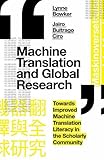
Machine translation and global research : towards improved machine translation literacy in the scholarly community / Lynne Bowker and Jairo Buitrago Ciro.
Material type: TextPublisher: Emerald Publishing Limited, Description: 1 online resource (xiii, 111 pages)ISBN: 9781787567214 (e-book)Subject(s): Machine translating | Research -- Cross-cultural studies | Computers -- General | Computer scienceAdditional physical formats: No titleDDC classification: 418.020285 LOC classification: P308 | .B69 2019Online resources: Click here to access online
 | Item type | Current library | Call number | URL | Status | Date due | Barcode | Item holds |
|---|---|---|---|---|---|---|---|
 eBook
eBook
|
Digital Library
Resources in this library are accessible in digital format e.g. eBooks or eJournals accessible online. |
P308 .B69 2019 (Browse shelf(Opens below)) | Link to resource | Available |
Includes bibliographical references and index.
Prelims -- Introduction -- 1. Scholarly communication -- 2. Machine translation -- 3. Expanding the reach of knowledge through translation-friendly writing -- 4. Some wider implications of using machine translation for scholarly communication -- 5. Towards a framework for machine translation literacy -- References -- Index.
In the global research community, English has become the main language of scholarly publishing in many disciplines. At the same time, online machine translation systems have become increasingly easy to access and use. Is this a researcher's match made in heaven, or the road to publication perdition? Here Lynne Bowker and Jairo Buitrago Ciro introduce the concept of machine translation literacy, a new kind of literacy for scholars and librarians in the digital age. For scholars, they explain how machine translation works, how it is (or could be) used for scholarly communication, and how both native and non-native English-speakers can write in a translation-friendly way in order to harness its potential. Native English speakers can continue to write in English, but expand the global reach of their research by making it easier for their peers around the world to access and understand their works, while non-native English speakers can write in their mother tongues, but leverage machine translation technology to help them produce draft publications in English. For academic librarians, the authors provide a framework for supporting researchers in all disciplines as they grapple with producing translation-friendly texts and using machine translation for scholarly communicationa form of support that will only become more important as campuses become increasingly international and as universities continue to strive to excel on the global stage. Machine Translation and Global Research is a must-read for scientists, researchers, students, and librarians eager to maximize the global reach and impact of any form of scholarly work.
Print version record
There are no comments on this title.